
 English
  French
  Spanish
  Turkish
  Russian
 Center Feed VS Corner Feed in Filter Press
In the structural design of filter plates in filter presses, the most common feeding methods are center feeding and corner feeding. The two methods differ significantly in terms of filtration efficiency and filter cake uniformity.
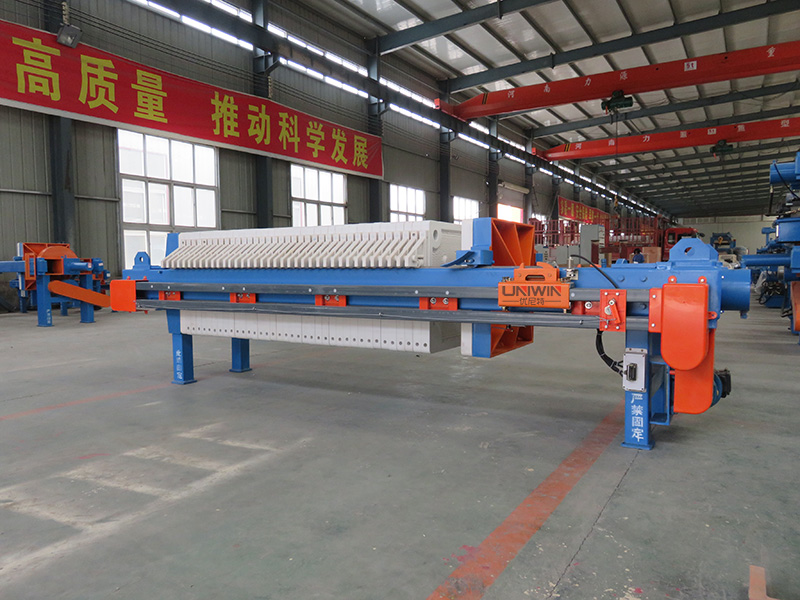
Difference between Center Feed and Corner Feed
Material distribution
Center feed: the feed inlet is located at the center of the filter plate. The slurry enters each filter chamber directly through a large-diameter hole in the center of the filter plate, resulting in a short and direct path.
Characteristics: the path is more symmetrical, theoretically making it easier to distribute the material evenly.
Corner feed: The feed inlet is located at the corner of the filter plate. The slurry enters through a small channel at one of the four corners of the filter plate and travels through a winding internal channel before reaching the filter chamber.
Characteristics: The area near the feed corner is impacted and accumulates first, making it more prone to flow deviation.
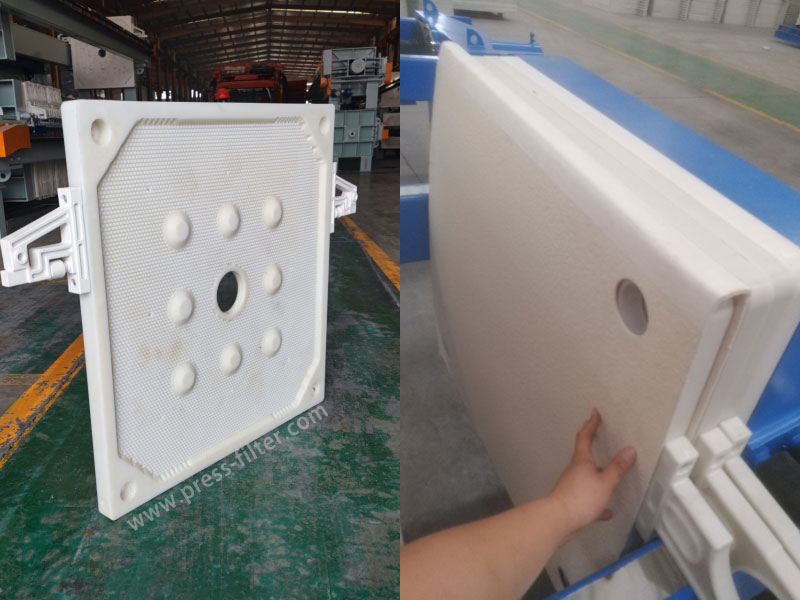
Impact on filter cloth wear/filter plate erosion
Center feed: Flow is more symmetrical, and the overall flow is less prone to long-term wear on a particular corner. However, the flow velocity is highest in the central area during the initial feeding phase. If the slurry contains sand/hard particles or there is significant pump pulsation, the filter cloth in the central area is prone to thinning first, and the filter plate/sealing area near the central perforation is more significantly eroded. A gradual increase in pressure during feeding is necessary.
Corner feed: The structure is relatively simple to implement and is used in many standard plate and frame filter presses. However, the area near the feed corner experiences high shear over a long period, making it more prone to localized wear through the filter cloth. If the feed is unevenly distributed, it can easily lead to “one corner wearing out while another corner accumulates,” resulting in a reduced lifespan.
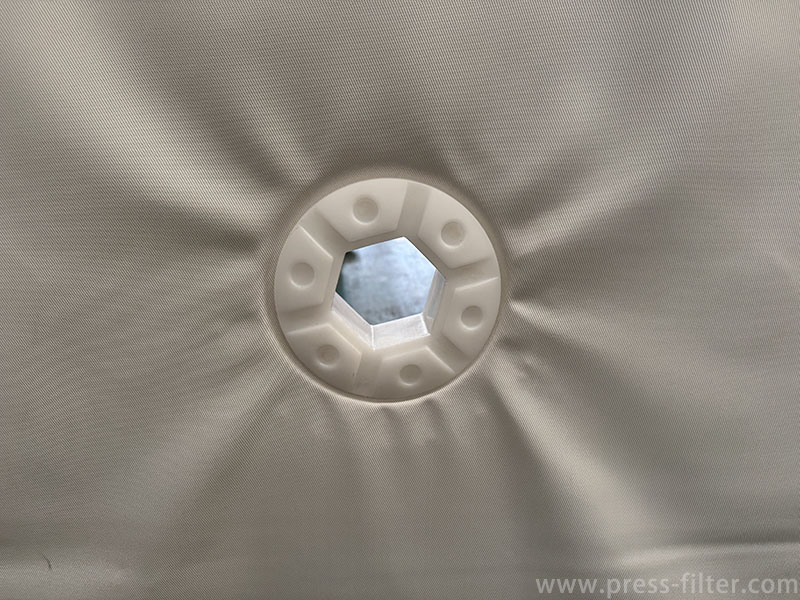
Comparison of clogging risks
Corner-feed systems have small internal channels with tortuous paths, making it easy for fibrous materials or larger particles to accumulate within the channels. This leads to uneven filling of the filter chambers, resulting in dangerous pressure imbalances and, in severe cases, filter plate rupture.
Center-feed systems utilize large-diameter central channels, allowing the slurry to fill each filter chamber quickly and evenly. Solid particles have a very short residence time within the channels, significantly reducing the probability of clogging.
Feed rate and filtration performance
Center feed (usually used with a concave plate filter press) allows for a larger central orifice, resulting in a higher feed rate and larger throughput, making it suitable for large-scale continuous operation. Most modern filter presses use concave plate center feed precisely because of this advantage.
Angle feed (common in plate and frame filter presses) has a smaller inlet and limited flow rate, leading to a significant decrease in efficiency when processing high-concentration or high-viscosity slurries.
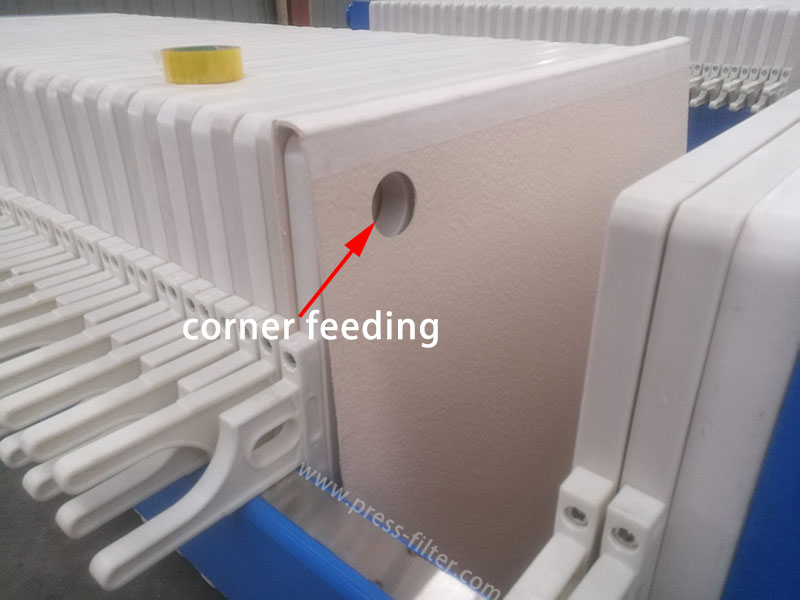
Filter cake formation
Center Feed: Material enters from the center of the filter plate and then diffuses evenly outwards. The material flow path is symmetrical, resulting in a relatively uniform pressure distribution throughout the filter chamber and more even solid particle deposition.
The filter cake thickness is generally consistent, with minimal differences in moisture content, and the filter cake structure is stable.
Corner Feed: Material enters through the corner holes of the filter plate and then diffuses throughout the filter chamber. The flow velocity is higher near the inlet, while filling is slower further away, resulting in uneven filtration pressure distribution.
The filter cake is thicker near the inlet and thinner in the diagonal areas.
Conclusion
Overall, center feed has become the mainstream choice in modern industry, with its large-diameter straight-through design offering superior reliability and throughput compared to corner feed. Corner feed is more commonly found in traditional plate and frame equipment or specific small-scale applications.